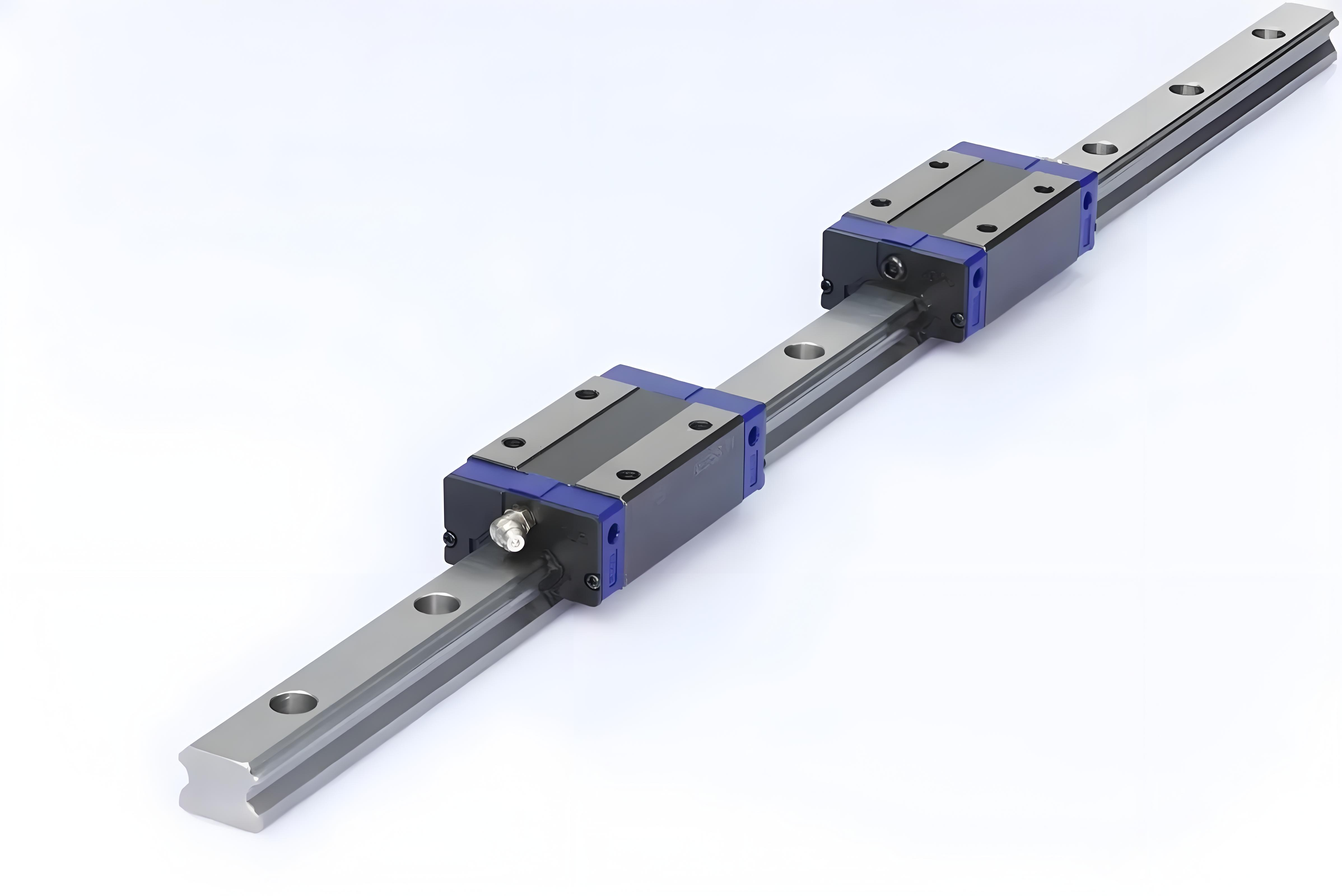
Linear guide is a key component widely used in mechanical equipment and automation systems, mainly used to achieve precise motion, guidance, and positioning of objects in the linear direction. The following are its main uses and advantages:
1. High precision guidance
Purpose: In situations where precise positioning is required (such as CNC machine tools, measuring equipment, semiconductor manufacturing equipment), linear guides use a low friction, high rigidity structure to ensure that moving parts move along a predetermined trajectory and reduce deviations.
Typical scenarios: tool movement in CNC machining centers, positioning of print heads in 3D printers.
2. Bearing and support
Purpose: Can withstand vertical, horizontal, and moment loads, disperse the weight of moving parts and external forces, and protect equipment structures.
Typical scenarios: Linear motion of industrial robot arms, heavy object handling in automated production lines.
3. Improve exercise efficiency
Low friction design: using ball or roller structure to reduce frictional resistance, improve movement speed and energy efficiency.
Typical scenario: Rapid reciprocating motion of high-speed packaging machinery and logistics sorting systems.
4. Long lifespan and stability
Wear resistant materials: Guides and sliders typically use hardened steel or coating technology to meet the needs of high-frequency and long-term use.
Typical scenarios: repetitive operations on automotive assembly lines, continuous production of injection molding machines.
5. Modularity and flexibility
Purpose: Standardized design facilitates installation and maintenance, allows for flexible adjustment of length and configuration, and adapts to different equipment requirements.
Typical scenarios: Track expansion of automated warehousing systems, customized renovation of laboratory equipment.
6. Adaptability to complex environments
Dustproof and Sealing: Some guide rails have dustproof, waterproof or corrosion-resistant properties, suitable for harsh environments.
Typical scenarios: Moving mechanisms for food processing equipment (in humid environments) and outdoor testing instruments.




 +86136-5047-7465
 手机站